In this entry we will discuss Auto carpet and why it is important in relation to the fibers found on Amy’s clothing. It has been said by Chief Spaetzel that the nutmeg colored fibers were traced back to a GM vehicle from the years of 1976 to 1978. I assigned a small group within our team to do some field work on the subject. This group spoke with carpet mills, auto restoration experts and the automakers themselves. Together we then analyzed the evidence photo of the fibers found on Amy. The goal was to form an independent opinion as to the origin of those fibers. In order to do this we must first get a good working knowledge of how automotive carpet is made, who was making it and what differentiates auto carpet made for GM vs Ford vs Dodge/Chrysler and others. In the early to mid 70’s auto makers had switched exclusively to two types of carpet. those two types are known as cut-pile and essex. Here are those two by their definition.
ESSEX (PLUSH) CARPET. Essex is a plush upgrade to cut pile and can be used in almost any model vehicle.Essex is composed of 100% Nylon yarn. Tufted to a 1/10 gauge cut pile, Essex contains 22.5 ounces of yarn per square yard giving it a luxurious and plush look and feel.
To appreciate the differences between the different materials of carpets offered, we need to understand how carpets are constructed.
By nature of the manufacturing process, all carpet is either Cut Pile or Loop carpet. The manufacturing of carpet involves sewing strands of yarn into a backing material. Left alone, this creates a Loop-style carpet. When these loops are cut, we have a Cut pile style of carpet.
What this all means: All Essex carpet is cut pile but not all cut pile is Essex. Essex carpet would most likely be be reserved for the more flagship models as it is thicker, more plush, better to the touch and also more expensive. Standard cut pile would be used on the mid priced to lower end vehicles.
Here are some examples of late 70’s vehicles that would have OEM Essex carpet.
Cadillac: Deville, Eldorado.
Buick: Riviera, Regency, Regal
Oldsmobile: Delta 88, Toronado
Pontiac. Grand LeMans, Bonneville
Dodge/Chrysler: Cordoba, Imperial, New Yorker
Ford/Lincoln/Mercury: Thunderbird, Continental, Marquis
Chevrolet: Conversion vans, Campers, Corvette
Now some examples of automobiles using standard cut pile carpeting
Chevrolet: Malibu, K pickup trucks, Chevy Van, Chevette
Pontiac: Grand Am, Firebird, Sunbird
Buick: Skylark, Century
Chrysler/Dodge: LeBaron, Aspen, Vans, Pickup Trucks
Ford: Pinto, Mustang, Econoline Vans, Pickup trucks
Now that we have some basic rough knowledge of the two types of carpet and their uses, let us delve into the mills a bit. Staying in the mind frame that we have only a handful of these auto carpet manufacturers, we must entertain that these mills were not used exclusively within the different automakers. Lets say for example, Mill 1 has received a large order for beige carpet from Buick. At the same time Ford is in need as well for a large order. Do we believe for one second that Ford would not use another mill to fulfill their demands? Nope, they will use whatever means is necessary to keep the assembly lines supplied with what they need. So if this means using mill number one or two, it makes no difference to them as long as they can get what they need in the time frames they need it by and that the carpet is the same from mill to mill. So with this in mind we start to see the uniformity necessary within the mills themselves. Do you think Mill 2 who is slow on orders from Pontiac is not equipped to handle and make carpet for other auto makers? Not a chance.
Uniformity
Now that we see that there are in fact very few carpet mills, let us now imagine just how few companies are actually making the machines to make this carpet. If you have only a handful a carpet makers making auto carpet, what is the demand for the machines to make it? These are fairly large and expensive machines. The answer is not too many. So what does this all mean? It means in order for these mills to stay in business they are equipped to produce carpet for any of the automakers and this requires uniformity. Buick can’t have a difference in carpet in half of their Regal models. The cars coming off the assembly line need to be uniform with each other. Just Imagine buying a car and saying, I like the white one but the red one has nicer carpet. It is highly unlikely. So to wrap up our findings based on common sense and some research with highly knowledged auto experts we must come to the conclusion that very few different machines made these carpets and that the mills ran carpet for multiple automakers at the same time with the only real difference in the carpet itself is in the color dying process. Now, much can be ascertained by the color of the carpet. The same beige is not likely to be installed in a Pinto as a Continental so different dyes are used to create different visual effects in the interiors of these cars. For example, a higher end vehicle may have more red hues in the beige to create a more rich appearance than a lower end vehicle.
Enter the Carpet sample found on Amy. what does it tell us. What information can we gather from this single photograph. Well, it tells us a lot actually.
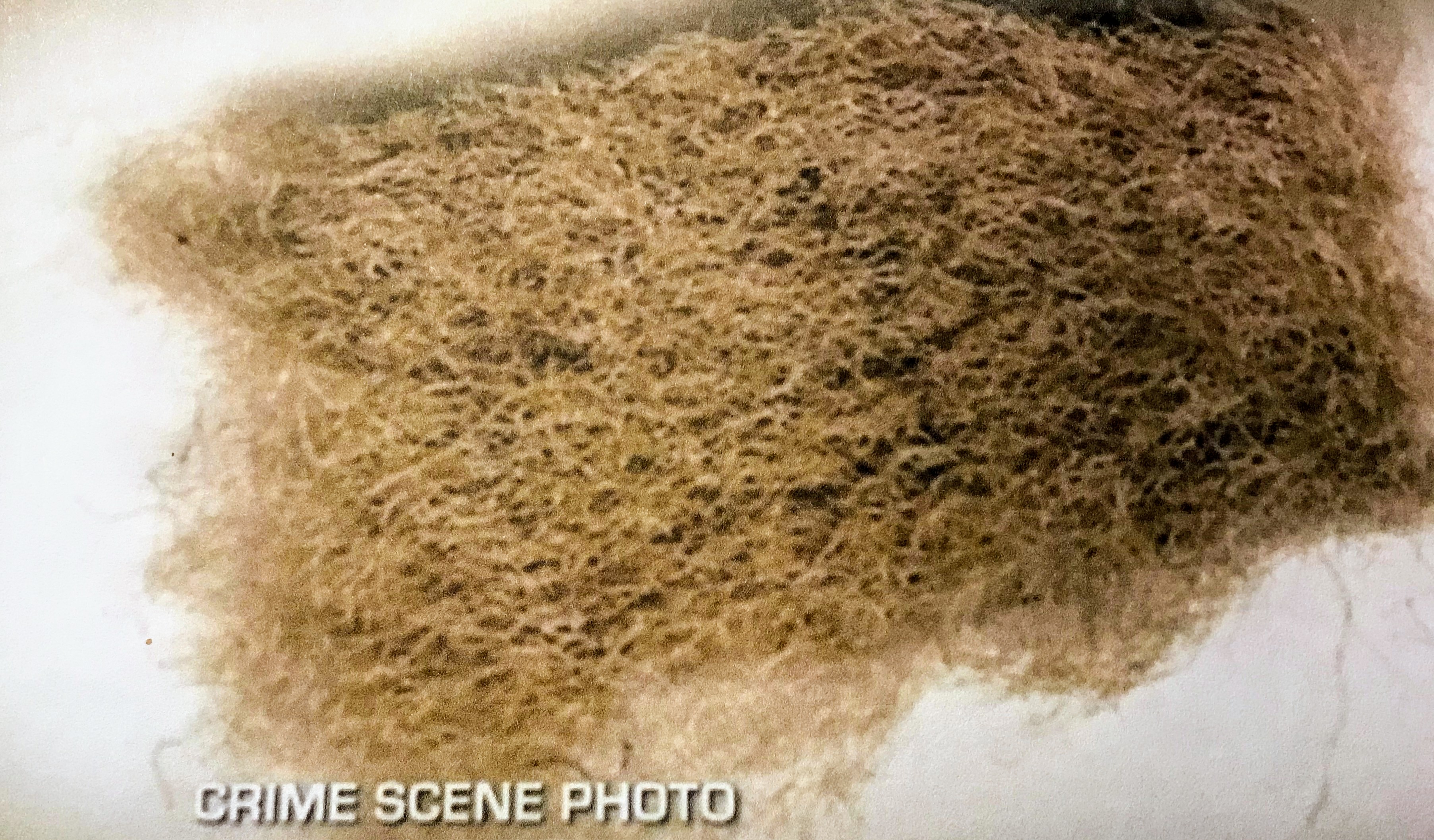
When the BVPD talks of these fibers, they seem to insinuate that they are working with only a few fibers when in fact this is not a few fibers. This is a good clump of carpet. This also tells us a lot about the carpet itself. During our research with the experts in auto restoration and the mills themselves we have established a profile of the sample itself. Here is that profile based on all factors and understanding the durability and weathering of the carpet as well as other environmental factors and the typical life expectancy of the carpet itself before it begins to break down and deteriorate.
1. The clump: In order for the carpet to come apart as a clump, this carpet must be heavily deteriorated in the backing material. Staying with the idea that the carpet made in the 70’s is not as durable as it is today and had a typical life expectancy of 8 to 12 years, we find this sample to be consistent with FBI analogy of the sample and it is from a vehicle from the years 1976-1978, give or take a year on either side.
2. The sample is weathered AND/OR was pulled off the carpet by mechanical force such as clawing at the carpet. The sample appears to be interior carpet and not trunk carpet. If you look at the photo you will see the molded backing material. this backing material is uneven and torn.
3. The color of the clump: Coloring from the dye process is well preserved and not heavily faded from UV rays. This suggests that the sample is from an area low in the vehicle and shaded from the Sun’s UV rays.
4. The type of carpet in the clump: If this is Essex it is highly worn from a high traffic area of the carpet but that is not consistent with the coloring of the sample. The evidence suggests that this is cut-pile carpet from a more shaded, less foot traffic area of the vehicle.
5. The degradation of the sample. You might ask yourself that if this sample is from a lower traffic area of the vehicle then how is it degraded enough to tear as shown? The answer is weathering and moisture and/or mechanical force. The sample suggests it is from a vehicle that is in an environment consistent with weather change, high humidity and has undergone many processes of hot/cold. The sample is not heavily UV damaged, it is from a more shaded area that is degraded from weathering and subject to radical temperature and humidity changes.
The conclusion: This sample can be from any of the automakers. The clump is suggestive to being pulled from a flat area. The backing material being torn is also indicitive of being pulled from a flat area. This lower traffic cut-pile carpet, shielded from UV rays, subjected to repeated sequences of varying temperates and humidity levels is from a 4 season region. Based on side by side color comparisons this sample is most alike to a Ford or Chevrolet. When all things are factored in this sample is from the back of a van that was shaded but likely not garaged.
We continue to ask the public to let us know about any suspicious vans in the Bay Village area in the early fall of 1989.
For more frequent information and to follow our investigation more closely, be sure to follow us on Twitter @realamyarmy
Blaze


 Amy Mihaljevic The pursuit of her killer